
Chaltén
The Tehuelche called it Chaltén, the mountain that almost always has a cloud stuck to its summit: the smoking mountain. In 1877 Francisco P. Moreno named it Fitz Roy, after Robert FitzRoy, captain of the Beagle. Both names live on.
1952: the French expedition
In early 1952 a French expedition reached the massif. One of its members, Jacques Poincenot, drowned crossing the Fitz Roy river before the summit attempt; the camp and one of the spires bear his name today. On 2 February 1952 Lionel Terray and Guido Magnone reached the summit of Fitz Roy for the first time. The street our office is on is named after Lionel Terray.
Cerro Torre
Cerro Torre has the most disputed story in mountaineering. In 1959 the Italian Cesare Maestri claimed to have reached the summit with Toni Egger, who died on the descent; the ascent was never proven. The first undisputed ascent came in 1974, by an Italian Ragni di Lecco expedition led by Casimiro Ferrari.
The Park and the town
Los Glaciares National Park was created in 1937 and UNESCO declared it a World Heritage Site in 1981. El Chaltén was founded in 1985 at the foot of the massif; that same year Alberto del Castillo arrived, and in 1995 Fitz Roy Expediciones was born. Read more →
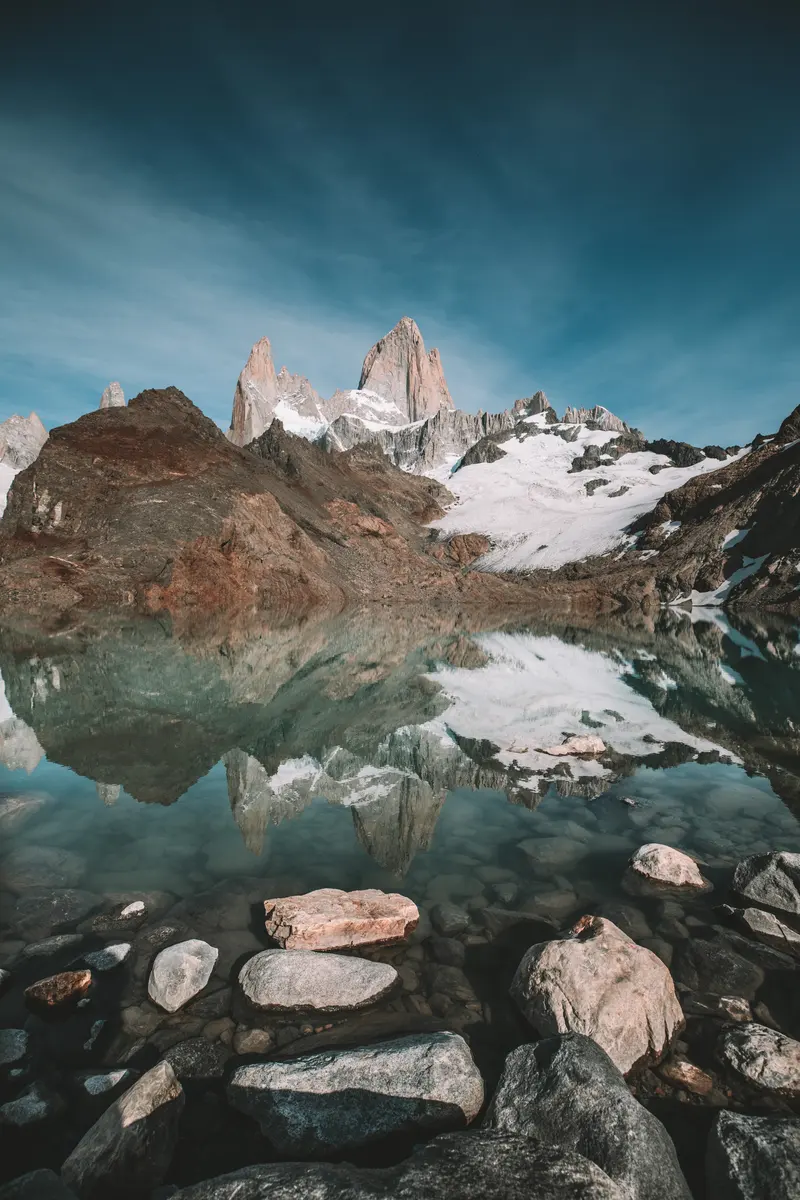 Laguna de los Tres18.3 km · +880 m · 8–10 h · from USD 228
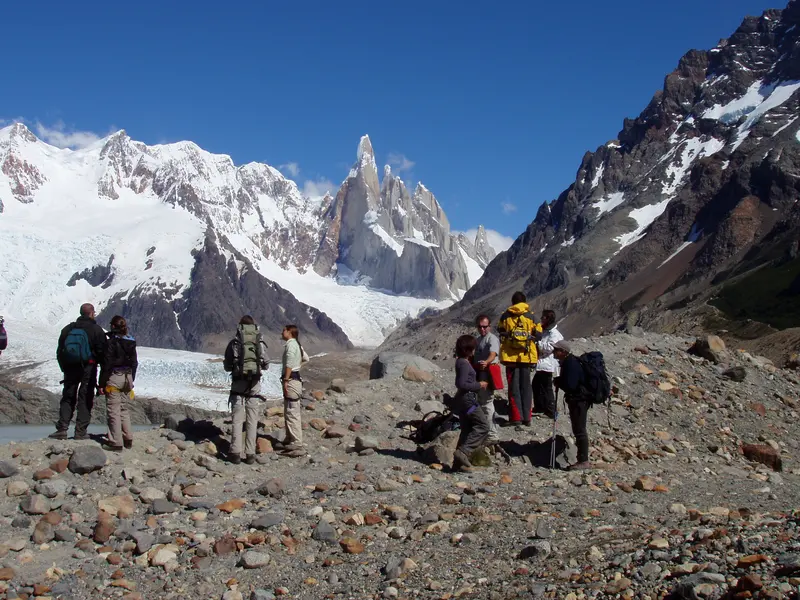 Laguna Torre16.6 km · +500 m · 7–8 h · from USD 203
Questions
What does Chaltén mean?
For the Tehuelche, the smoking mountain, for the cloud almost always on its summit.
Who first climbed Fitz Roy?
Lionel Terray and Guido Magnone, on 2 February 1952, with a French expedition.
When was El Chaltén founded?
In 1985.